Sleep science & mattress education
What to Look For in an Organic Crib Mattress
Choosing a crib sleep surface is not simply a matter of finding a natural material or an organic label. The first priorities are a mattress that fits the crib correctly and provides a firm, flat surface. After those essentials, construction, certifications, care instructions, and the clarity of a manufacturer’s claims can help families compare options with greater confidence.
Published October 19, 2026
A crib mattress occupies a modest space in a nursery, but its role is unusually important. It is the surface where an infant spends many hours, and it must work as part of a carefully prepared sleep space—not as a decorative or comfort-enhancing layer. The quiet work of choosing one begins with practical questions: Does it fit the crib? Is it firm and flat? Can its materials and certifications be understood? Can the family follow the care instructions without adding unapproved layers?
The word organic can make a mattress sound self-explanatory. It is not. The term may refer to a particular textile or ingredient, and a certification may apply to some components rather than every part of a finished mattress. Organic status does not, by itself, establish that a mattress is the right size, sufficiently firm, compatible with a specific crib, or suitable for infant sleep. Those questions deserve separate answers.
This guide offers a way to examine organic crib mattresses without letting appealing language eclipse the fundamentals. It is general educational information, not a substitute for current public-health guidance, the mattress and crib instructions, or advice from a child’s clinician. Safety standards and recommendations can change, so families should consult current guidance from relevant government and pediatric health authorities.
Start with fit: the mattress must belong in the crib
A crib mattress should be designed for the crib in which it will be used. A close fit helps avoid gaps at the edges, where an infant could become trapped. Do not assume that two products described as “standard” will necessarily fit together: dimensions can vary, and the shape or construction of a particular crib can matter. Check the crib manual and mattress specifications, and follow the manufacturers’ fit instructions.
When the mattress is placed in the crib, it should lie flat and sit securely within the frame. The edges should not curl, bow, or leave obvious spaces. If the crib and mattress are sold separately, verify compatibility before use rather than relying on a retailer’s shorthand description. For a used crib or a mattress passed between households, confirm that both items are intact and that their instructions and safety information are available.
Fit is not a one-time consideration. Recheck it after adjusting the crib’s mattress support, moving the crib, or replacing the mattress. Ensure the support is installed as directed and that the mattress remains level. A mattress that has become misshapen, damaged, or visibly compromised should not be treated as though its original fit still guarantees a safe surface.
Mattress thickness and crib construction also belong in the same conversation. The relevant question is not simply whether a mattress is “thick” or “thin,” but whether it is intended for the crib, fits securely at the support setting being used, and follows the crib maker’s instructions. Avoid improvising with boards, folded blankets, extra cushions, or other materials to correct a poor fit. If the combination seems uncertain, pause and seek clarification from the manufacturers or a qualified safety resource before using it.
Firm and flat matter more than plush
For infant sleep, the mattress should provide a firm, flat surface. “Firm” in this context does not mean uncomfortable to an adult’s hand, nor does it mean a mattress must feel hard in every respect. It means the sleep surface should not conform deeply around the infant or create a soft, yielding hollow. A surface that feels luxurious to an adult may not be appropriate for a crib.
Do not use an adult mattress, soft topper, pillow, quilt, padded insert, or other cushioned layer to make a crib mattress feel softer. Added layers can change the surface and may introduce hazards. Likewise, a mattress advertised as orthopedic, pressure-relieving, or exceptionally cushioned should not be assumed suitable for infant sleep based on those claims. The product needs to be specifically designed for a crib and used according to current infant safe-sleep guidance.
Descriptions such as “natural,” “breathable,” or “temperature regulating” may explain a material or a manufacturer’s intended feature, but they are not substitutes for firm, flat construction. Nor should a parent need to alter the mattress to achieve a safe surface. If the mattress has a pronounced dip, uneven area, loose component, or other defect, stop using it and contact the manufacturer for guidance.
Once the mattress is in place, the sleep space should remain simple. Use a fitted sheet that is designed to fit the mattress securely, and keep loose bedding and soft objects out of the crib. Follow current public-health safe-sleep guidance for the child’s age and circumstances; do not rely on product marketing to resolve questions about sleep positioning, bedding, or accessories.
Read organic claims as carefully as the construction
Organic crib mattresses can use a range of materials, such as cotton, wool, or latex, and they can combine them in different ways. A label may refer to the fiber in a cover, a filling, or another component. Ask what, precisely, is organic: the fabric, the batting, a portion of the filling, or the complete product? A useful description identifies materials and where they appear in the mattress rather than relying on a broad headline claim.
It also helps to distinguish between a material description and a verified certification. Words such as “natural” and “eco-friendly” can be used in different ways and may not tell a reader how a product was made or assessed. A named certification has a defined scope and rules, but those rules apply only to what that certification covers. Look for the certifier, the relevant standard, and the product or component included in the certification. If a company offers a certificate number or a public directory entry, check whether it can be verified and whether it corresponds to the mattress being considered.
For example, GOTS—short for the Global Organic Textile Standard—is associated with organic textile processing and products within the standard’s scope. Its presence on a document does not automatically certify every non-textile part of a mattress, and the precise claim should be checked against the certification information. Other labels may address different questions. Rather than treating all seals as interchangeable, read what each one evaluates and what it does not.
Certification can be a helpful way to make complex supply-chain information more legible, but it is not a complete safety verdict. A certified fabric does not tell a family whether the mattress fits a crib. It does not replace a review of firmness, construction, condition, care directions, or applicable product requirements. The most informative manufacturers explain both the certified scope and the remaining components in plain language.
Material transparency is valuable for another reason: it gives families a way to evaluate sensitivities and preferences without turning them into guarantees. If a household is concerned about a particular material, ask whether it is present, where it is used, and whether there is relevant documentation. Avoid assuming that “organic” means allergen-free, chemical-free in an absolute sense, or appropriate for every child. Those are broader claims than an organic material designation alone can support.
Look inside the mattress description
A mattress is a layered object. Its outer fabric, interior filling, support structure, seams, and any waterproofing or barrier layer can differ in material and purpose. When reviewing a product description, look for a clear list of these components. If the information is too vague to tell what the infant will be sleeping on, ask the manufacturer for specifics before deciding.
- Cover and ticking: Find out what fabric is used and whether the cover is fixed, removable, or intended to be cleaned in a particular way.
- Core and filling: Identify the support structure and any cotton, wool, foam, latex, or other filling. Do not infer composition from a product name alone.
- Waterproofing: Ask whether a moisture barrier is built into the mattress or provided as a separate accessory, and follow directions for any approved cover.
- Assembly and seams: Check that the product is complete, undamaged, and free of loose or exposed components when it is set up.
- Care instructions: Note whether the mattress can be spot-cleaned, whether a cover can be laundered, and how it must be dried before reuse.
Construction language should clarify the product, not encourage experimentation. For example, a removable cover may be convenient, but it must be reinstalled as directed and must not alter the mattress’s fit or surface. A separate pad may protect against moisture, but that does not mean every pad is appropriate for a crib. Check the crib and mattress instructions and current safe-sleep recommendations before adding any accessory.
Care, waterproof layers, and everyday mess
Infant care involves spills and frequent laundry, so maintenance is not a minor detail. Before purchasing, learn what the manufacturer permits: spot cleaning, removal of a cover, machine washing, drying time, and any restrictions on detergents or cleaning products. These directions can affect how practical a mattress is in a real household. A mattress that cannot be cleaned as a parent expects may prompt the use of extra layers that have not been approved.
Waterproofing is often described as a convenience or a way to protect the mattress. The important distinction is whether it is an integrated part of the mattress or a separate pad, and whether the maker and current safe-sleep guidance permit that accessory. A pad must not bunch, shift, create a soft or uneven surface, or interfere with a snug sheet. Do not use a product simply because it is marketed for babies or described as breathable or organic.
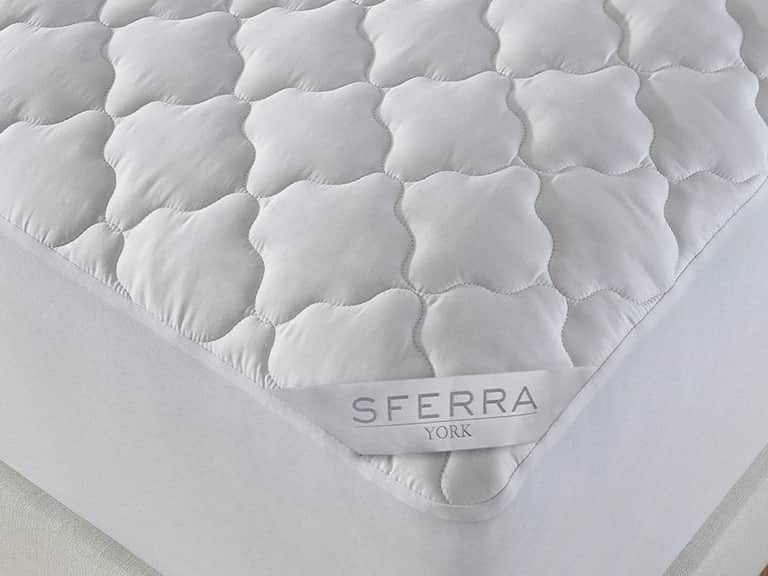
One example of a separate bedding accessory is the Naturepedic Waterproof Organic Cotton Crib Mattress Pad – Flat. Its description identifies organic cotton layers and a waterproof inner layer, and gives dimensions of 28 by 52 inches. It is a pad, not a crib mattress, and its material description does not establish that it will suit every mattress, crib, or safe-sleep setup. Before using any pad, check its fit and instructions against the mattress and crib guidance, and consult current infant sleep recommendations. If there is uncertainty, leave the accessory out and seek authoritative advice.
Never improvise a waterproof layer from plastic sheeting, folded cloth, or another household material. Do not stack pads or sheets to make a surface more protective. The goal is a clean, correctly fitted, firm, flat sleep surface—not the maximum number of layers between the infant and the mattress.
Check safety information, condition, and history
Before use, inspect the mattress for damage and confirm that its labels and instructions are available. Look for the model name, manufacturer details, date or batch information where supplied, and any stated warnings. Keep the packaging or purchase records if practical; they can help with questions about care, warranty, or a safety notice. Do not remove or disregard labels that provide essential product information.
Check for current recalls or safety notices using reliable official sources, especially when considering a secondhand mattress. A used product may have an unknown history: it could have been stored damp, cleaned in a way that affected its construction, or paired previously with a different crib. Wear, sagging, tears, loose seams, or an unpleasant persistent odor are reasons to investigate rather than cover the problem with a sheet or pad.
Do not assume that an item is suitable simply because it was used by another family, is described as barely used, or looks clean. Follow the manufacturer’s instructions on the mattress’s condition and expected use. If the mattress has been modified, repaired, or exposed to conditions that the maker does not permit, ask the manufacturer whether it remains appropriate. When its history or integrity cannot be established, choosing a known, intact product may be the more cautious course.
Families with questions about a particular infant, health condition, or sleep arrangement should consult a qualified health professional and current public-health guidance. Product pages and consumer reviews can provide useful details, but neither replaces medical advice or official safety information.
A practical comparison checklist
Side-by-side comparison becomes clearer when the same questions are asked of every mattress. Keep the answers factual, and treat missing information as a prompt for follow-up rather than as proof that a product is unsuitable or suitable.
- Compatibility: Is this mattress specifically intended for the crib, and do the crib and mattress instructions confirm a secure fit?
- Surface: Is it designed to provide a firm, flat crib sleep surface without added cushioning or modification?
- Dimensions: Are the measurements and any fit guidance clear, and does the mattress sit properly in the actual crib?
- Materials: Are the cover, filling, core, and barrier described separately and in understandable terms?
- Certification: Which organization or standard is named, what component does it cover, and can the claim be verified?
- Care: Can the family follow the cleaning and drying directions, and are any accessories clearly addressed?
- Condition and records: Is the product intact, traceable, and free of unresolved safety notices or modifications?
- Claims: Are performance statements specific and explained, or do they rely mainly on words such as “pure,” “safe,” or “chemical-free”?
This checklist does not rank products or replace current regulations. It is a method for separating essential use questions from material preferences. If a manufacturer’s answer is unclear, request written clarification and compare it with the crib manual and relevant official guidance.
Common assumptions worth questioning
“Organic means safer in every respect.” Organic status describes a material or a defined production scope; it is not a substitute for fit, firmness, sound construction, or appropriate use. Consider those qualities independently.
“A mattress that feels soft to me must be comfortable for a baby.” Adult comfort is not the measure for an infant sleep surface. Follow current safe-sleep guidance and choose a crib mattress designed to be firm and flat.
“Breathable materials remove the need to follow sleep guidance.” A material description is not permission to add bedding or change an infant’s sleep setup. Use the mattress as directed and keep the sleep space simple.
“A pad is part of the mattress.” A pad is a separate accessory unless the manufacturer explicitly identifies it as an integrated component. It may change the surface and should not be added without checking compatibility and guidance.
“A certification covers the whole product.” A certificate has a defined scope. Verify the standard and the components included rather than assuming that one seal applies to every layer and feature.
“If a mattress fits now, it will always fit.” Recheck after adjustments, movement, or a change in equipment, and pay attention to damage or changes in shape over time.
Choose with evidence, then keep the sleep space simple
An organic crib mattress can be a considered choice for families who value particular fibers, sourcing, or certification. The strongest decision, however, is not made by a label alone. It comes from confirming a secure fit, a firm and flat surface, clear construction, verifiable claims, and care instructions that can be followed. These fundamentals apply whether a family chooses organic materials or not.
When the mattress is installed, follow the crib and mattress manuals, use only a fitted sheet that fits securely, and keep the sleep space free of unapproved soft items and improvised layers. If an accessory seems necessary, confirm that it is permitted and compatible before use. A simple setup is easier to inspect, clean, and maintain—and easier to compare with reliable safe-sleep guidance.
In the end, a mattress is both a material object and part of a wider system: crib frame, support, sheet, room, and daily care. Looking at those elements together helps families move beyond broad promises toward practical questions they can answer. The most useful product information is precise; the most useful choice is one that fits the crib, follows current guidance, and can be used exactly as intended.